The Church’s liturgical year is punctuated by the feasts of Catholics whose lives have demonstrated heroic virtue and divinely attested sanctity. These are the men and women whom we call “blessed” because either popular acclamation or formal canonization by the Church has determined that they enjoy beatitude in Heaven after worthy lives on earth. They make up that part of the community of saints we call “the Church Triumphant”.
Those Catholics who continue to labor here on earth for the Kingdom of God constitute the “Church Militant”. Within that company are the monthly and annual dinner speakers hosted by Catholic Citizens of Illinois whose life and work has gained them some renown. We are happy, by the grace of God and the generosity of our benefactors, to have access to these important Catholics with something meaningful to say to our members and guests. But we know that the vast majority of good and faithful lay Catholics live lives of hidden virtue and sacrifice of which only those most familiar with them will be aware. These are men and women who, in the course of their daily lives and with no fanfare, recognition or thanks, take care of their families, their neighbors and co-workers, and their civil and religious communities. They rise early, retire late and contribute in countless ways to the spread of the Gospel, the glory of God and the good of their fellow man.
On an occasional basis, this space will be dedicated to an interview with or biography of such a person. We all know, love and depend on people like this in our daily lives. We invite you to help us by suggesting names of lay men and women who deserve to be honored as exemplary Catholic citizens in this way.
The first person to be honored as a “Catholic Making a Difference…” is Miss Nell Andrzejewski, the founder and director of Catholic Church Tours. Founded in 2010, this company provides an opportunity for pilgrims to visit some of Chicago’s most beautiful Roman Catholic and Byzantine churches under the tutelage of professional guides.
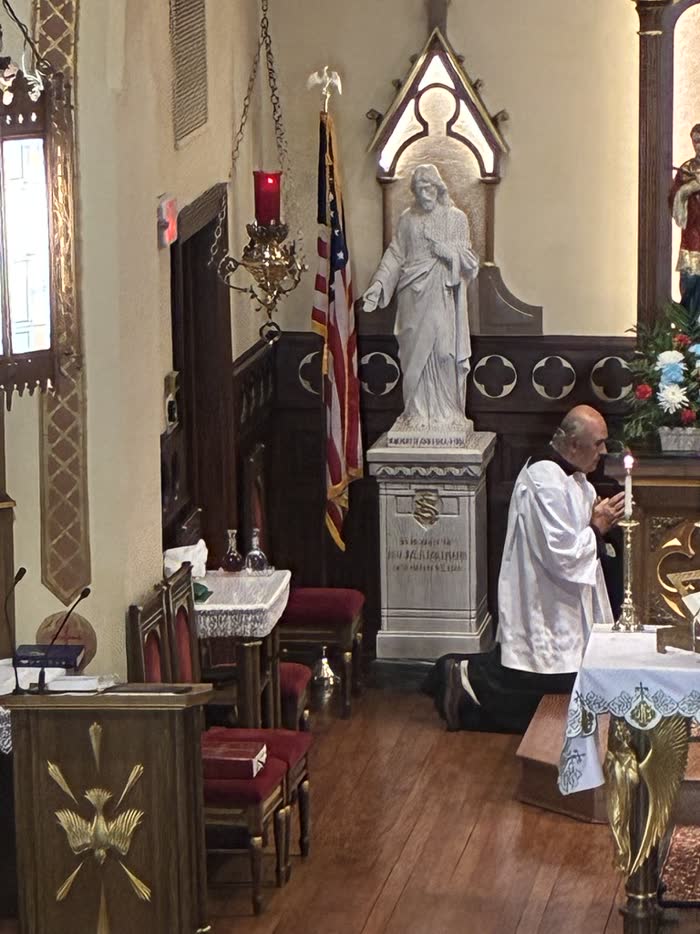 The next person to be honored as a “Catholic Making a Difference…” is Mr. Michael F. Haklin (“Dr. Mike”), sacristan at St. James Sag Bridge Mission Church in Lemont. As Catholics, when we think about – or pray for – vocations, we typically rightly – though reductively – think about vocations to the priesthood or the religious life. But, as the writings of St. John Henry Newman and Magisterial documents of and since the Second Vatican Council have made abundantly clear, members of the Christian laity have their own special and irreplaceable vocations in the world. Christian baptism confers a “universal call to holiness”. In the words of Pope Pius XII, “…the Faithful, more precisely the lay faithful, find themselves on the front lines of the Church’s life….”
The word “vocation”, of course, derives from the Latin “vocationem” which means “a calling; a being called”. Our latest lay Catholic Citizen Making a Difference, Mr. Michael Haklin, has responded to more than a few calls in his long, faithful and fruitful life. Mr. Haklin currently serves as sacristan at St. James Sag Bridge Mission Church in Lemont. Mr. Haklin (known at the parish as “Dr. Mike”) has dedicated his life since his retirement from a 45-year career as Director of the Surgical Research Lab at Rush University to the training and spiritual formation of the altar boys of the St. Thomas à Kempis Guild at St. James. He is also responsible for the catechesis and spiritual formation of the young ladies enrolled in the Daughters of Mary, Help of Christians Guild.
Dr. Mike, we at Catholic Citizens of Illinois are pleased to welcome you as the latest lay Catholic Citizen Making a Difference. You have answered vocations to the married life, to fatherhood, to the service of this country in the United States Navy, to a professional career training medical students and surgeons on the use of new equipment and techniques in the operating room, and most recently to the training and catechesis of young boys and girls at St. James Sag Bridge Mission Church. You were raised during an era in the life of the Church that might be unfamiliar to many young Catholics today. Will you please tell us a bit about your upbringing and your own early spiritual formation? What about your early life and education equipped you to remain close to the faith and to bring so many others – your own nine children and those you have trained and influenced through the Thomas à Kempis Guild and the Guild of the Daughters of Mary – to active participation not just in the liturgy but in Catholic life generally? Were you an altar boy? Do you have fond memories of your years in that role?
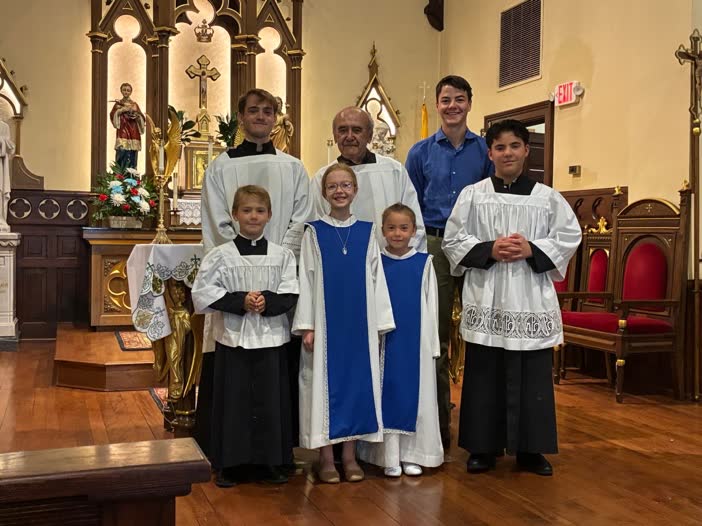 Dr. Mike: I was born in Chicago in 1940. My training as a server began when I was a page boy (a kind of apprenticeship for an aspiring altar boy) at St. Stephen’s Catholic Church. I began my training as an altar boy in the third grade. Sister Teresa was our instructor. We had to learn Latin for Masses and Benedictions.
I was blessed to have been raised by good, traditional Catholic stock, from my grandparents, to my godparents to my own parents. It was good to have had so many good Catholics in my extended family, since my own mother passed away when I was seven years old.
In fourth grade, our family moved to the Chesterton, Indiana area. I walked to church and always served the 5:30 am Mass on Sundays. I remained an altar boy through high school. I never lost my faith – never even questioned it.
Please tell us about your beloved late wife of 55 years, Rochelle. Where did you meet?
Dr. Mike: I met my wife, Rochelle, at a wedding. At the time, we both owned horses and were very interested and active in horsemanship. We had nine children – six girls and three boys. We lost one of our sons to bone cancer. Since I was in the medical field, I began researching cancer and developing therapies. I had some success and was glad to be able to study and contribute in this area of medical practice.
How did the two of you divide your responsibilities for the children, especially as to the way you fostered their spiritual lives?
Dr. Mike: At the time we met, my wife was a Lutheran, but from the start, she was very interested in becoming a Catholic. Even before her conversion, she always went to Mass with me. Since I knew Fr. Flannery from the local St. Rene’s Parish, in no time, her conversion was complete. My wife was very apostolic and helped many lukewarm Catholics.
May I ask if your children and grandchildren remain faithful Catholics?
Dr. Mike: Of the six girls, only one seems to harbor some questions about the faith, and so, of course, we pray for her.
To what in their upbringing do you attribute this fidelity?
Dr. Mike: I have always thought that the best way to keep one’s children faithful is to show them by example rather than by preaching.
What was the nature of your work with the medical students and surgeons at Rush during your five decades with the hospital?
Dr. Mike: I began as a civilian operating room technician at Presbyterian-St. Luke’s Hospital after my discharge from the Navy in 1961. At that time, the Hospital was not recognized officially as a university program. In 1973, it became Rush University Medical Center. The Medical Center needed a surgical research laboratory as well as protocols and courses for the use and operation of that laboratory. The chief of surgery at the time designated me to establish the requisite courses for the medical students. In addition, I supervised a master’s program curriculum for second year surgical residents. Each such resident would spend one year with me and then write and defend a thesis. Many hundreds of these research papers were published by doctors under my tutelage.
The first heart transplant in Chicago carried out from laboratory to clinic took place at Rush Medical Center in 1968.
I trained hundreds and hundreds of surgeons in many disciplines who took what they learned at our laboratory out into private practice.
I retired from Rush in 2013.
Although the hospital itself was a secular institution, did you find opportunities to evangelize these students who were preparing for a career wherein they were – quite literally – to hold the lives of their patients in their hands?
Dr. Mike: As to the medical students, that was a bit of a challenge. One had to be careful in questioning them too much. The problem was their keen intellects. They wanted to rationalize everything and were often lacking humility in their approach to the faith. Many had had no spiritual upbringing and had never practiced their faith. Even now, I say to young students thinking of a medical career, “be careful of medicine”. And be careful in your choice of the spouse you choose to marry.
At St. James, only altar boys serve at the Mass. What is your response to parents who want their daughters to serve at the altar?
Dr. Mike: The fact is that, if our Lord had wanted women taking His role as priests, He would have said so. As a result, the Catholic Church does not have the authority to ordain women as priests. Honestly, neither Fr. Koys as pastor nor I as sacristan have had an issue with parents lobbying for altar girls. Should such an occasion arise, we would explain the reasons for reserving the role to boys and young men. I know for sure that some of the altar boys would not serve if girls were admitted to that role which should be reserved for boys.
With Fr. Koys retiring, we do not know anything at the moment about his replacement. We pray every day for a good and holy priest as his successor.
The Maidens of the Bells ring the bells at appropriate times during the Mass. Their role is an important one, but they are not on the altar, and their responsibilities have nothing to do with those of an altar boy.
You and your wife were blessed with both sons and daughters. Over your lifetime as a parent and now as the sacristan in charge of training both boys, as altar servers, and girls, as bell ringers and Daughters of Mary, what differences do you see between the religious sensibilities of boys and girls?
Dr. Mike: Boys and girls are definitely different. St. John Bosco initially thought that his vocation should be to the boys alone, but our Lord and our Lady insisted that he had a mission to girls and women as well. This is why, on the Feast of the Immaculate Conception in 1878, he published the Rule for the Congregation of the Daughters of Mary, Help of Christians. Their patron saint is St. Mary Mazzarello who served as the Co-Foundress and first Superior of the Order.
Almost all the boys and girls in my programs are from home-schooled families which makes my job a little easier in doing presentations to them. Generally, though, I find that the boys are a little more serious and attentive than the girls.
What is the role for the girls in the Guild of the Daughters of Mary, Help of Christians at liturgies and otherwise?
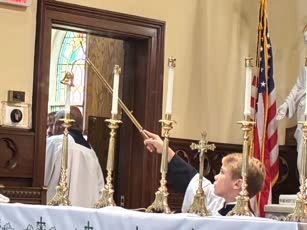 Dr. Mike: The goal with the girls, as with the boys, is sanctity. I encourage the girls to live their lives in imitation of the Blessed Mother and to follow the example as well of St. Mary Mazzarello. At the Mass, they play the small bells at the time of the Opening Antiphon as well as at the Consecration to help the congregation silently to pray “Jesus, I adore You; May my life be for You; How I love You!”
The liturgies, both Ordinary Form and the Extraordinary Form at St. James are celebrated with great reverence and decorum.
The goal for both the Traditional Latin Mass and for the Ordinary Form is sanctity and reverence. It is not possible to “split Christ in two”.
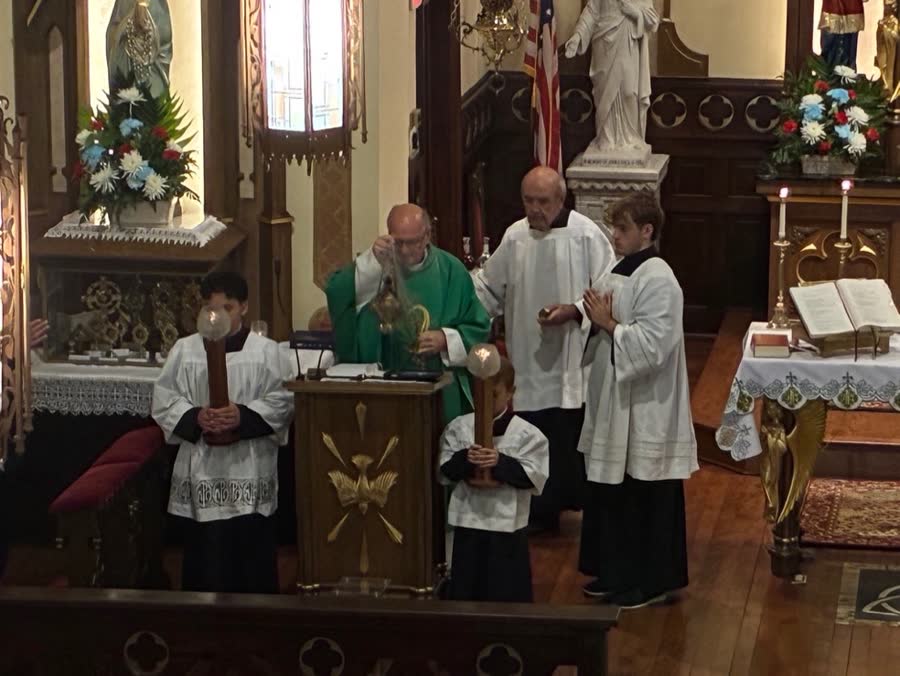
Some of the boys begin when they are barely taller than the candles they carry. Please tell us something about how you train the boys. One thing that strikes me especially is the respect the boys show not only for the Eucharist with their genuflections, but also the respect they show for the celebrant, reverencing the priest before and after handing him something and before and after incensing his person or the Scriptures. Why is this deference important?
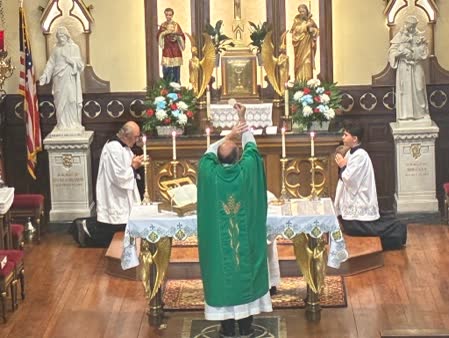 Dr. Mike: I impress on them how important it is to consider this question: “Do you realize Whom you are serving? Is it the priest – or Jesus Himself – Body, Blood, Soul and Divinity?” I tell them to look at the angels guarding the tabernacle. “Do the angels move around and fidget with their hands? Then, neither should you!!” Sanctity and reverence are absolute prerequisites for the boys. I watch them closely so that I can correct any problems I sense right away before they become habits.
The formation program for the altar boys is called the Thomas à Kempis Guild. The crucial question is “What does God want of you?”
The most important quality in a good altar boy is that he truly loves serving the Mass.
Aside from their knowledge of the parts of the Mass, the responses, and their responsibilities at the altar, what personal and spiritual qualities does the strict altar boy training you provide foster in the young boys and men under your tutelage? And the girls through their education and formation in the girls’ Daughters of Mary: Help of Christians Guild?
Dr. Mike: To achieve sanctity, you need a guild or a coach. I tell the young boys and girls that that is why it is important to have me guiding them and to pay attention to what I teach them. You cannot do it on your own! They are given pens, pencils, highlighters, notebooks, and spiritual reading materials which they are expected to use. Although our sessions are only one hour, I expect notes to be taken especially on very important matters.
During your service in the Navy, you would have had direct experience of a chain of command and the growth in maturity and leadership that takes place as a man moves up the ranks. Please explain how this process of maturation takes place among the altar boys.
 Dr. Mike: I joined the United States Navy in 1958 as a hospital corpsman, a special program. I served until 1961. I worked as head operating room technician.
If a boy shows interest in becoming an altar boy, first of all, he must be old enough. Age and maturity make a big difference. Some catch on quickly; others need a probationary period. The second thing has to do with how they conduct themselves on the altar. Do they genuflect correctly? Do they know how to fold their hands? Do they know how to sit correctly? Do they know not to look at the congregation, especially during Holy Communion?
As in the military service, obedience and respect while serving at the altar are the most important qualities.
Your curriculum includes more than training for altar service and devotion to the Blessed Mother. You also catechize both the boys and the girls with spiritual reading and direction. What resources do you use for this catechesis?
Dr. Mike: Both the boys and the girls are given a copy of the little book My Imitation of Christ. This has been called the book that has made more saints than any other, after the Bible. The girls also receive a copy of a biography of St. Mary Mazzarello. Members of both guilds are also assigned reading about vocational discernment by St. John Paul II. The boys have biographies of St. John Bosco and his student St. Dominic Savio as well.
How, in your opinion, does this additional formation enhance the piety they bring to their respective ministries? And to their relationship with Christ and His Church?
Dr. Mike: I tell them that is very important to ask themselves “What does God want of you?” The training I give them is not just for the present time or until they graduate, but for future reference for the rest of their lives.
I understand that you have a special devotion to St. John Bosco, the 19th century Salesian priest best remembered for his tender yet disciplined approach to the formation of young boys, even those with troubled backgrounds. If they were asked, would the young people with whom you work find that your approach more closely resembles that of St. John Bosco – or the United States Navy!!??
Dr. Mike: I don’t know how the youngsters would answer the question, but this is what I hope they would say because it is the truth. There is no comparison whatsoever between the United States Navy and St. John Bosco. The discipline of the Navy cannot begin to compare with St. John Bosco – doesn’t stand a chance next to that great saint. The Navy could use the discipline of John Bosco, especially in spiritual matters. The rampant immorality and general unbelief among most members of every branch of the service is a scandal. Their chaplains cannot even really talk about sanctity. Even for priests – I know that John Vianney is their patron saint – but, in my opinion, they should take the example of St. John Bosco. He is the best!
Dr. Mike, with becoming humility, concluded our interview with the words “With God’s help and Mary’s”.
Thank you, Dr. Mike, and congratulations on your many accomplishments and on being the Catholic Citizens of Illinois’ most recent Catholic Citizen Making a Difference!


