“Religious socialism, Christian socialism, are contradictory terms; no one can be at the same time a good Catholic and a true socialist.”
As with any disputed topic, it is important that terms be defined carefully. This is particularly the case regarding this topic due to the semantic similarity between “socialism” on the one hand, which has been consistently condemned by the Church, and “social justice” or “social welfare”—undeniably distinguishing marks of Christians—on the other. Conflation of these terms results in muddy argumentation, condemnation and vilification of one’s opponents and division even among fellow Catholics. It is further complicated by the broad spectrum of socioeconomic systems identified in some way or another as socialist—from classical socialism to radical socialist communism to democratic socialism to so-called religious or Christian socialism. Another source of confusion arises from a perceived similarity between the stated ends—if not the means—of democratic socialism and Catholic moral teaching. For the purposes of this summary, socialism should be understood broadly as an economic and political system in which a central government exercises a high—if not absolute—degree of control, whether by ownership or regulation or coordinated planning, over the economic decisions and means of production of the country. A government which provides generous social benefits to its citizens does not necessarily constitute a socialist government. The determining factor for whether a system is socialist is not, therefore, a matter of how much welfare it provides. It is rather a function of the degree and severity of the control over the economy made at the centralized level rather than by decisions made by free subsidiary individuals, companies, local authorities and communities.
Since the mid-19th century, a number of popes have denounced socialism repeatedly and unconditionally. In 1849, in the wake of a series of destructive revolutions that racked the continent of Europe, Pius IX denounced in the strongest possible terms the “wicked theories…the pernicious fiction” and rash errors of socialism and Communism (Nostis et Nobiscum). The most consistent and vociferous early voice against socialism, however, was that of Leo XIII. In several encyclicals, beginning with Quod Apostolici Muneris in 1878, Leo XIII wrote with great urgency against the vast range of evils associated with socialism. The most famous among these is the 1891 encyclical Rerum Novarum—On New Things. Among the new things Leo was addressing were the income and influence disparities between capital and labor and the resulting worker unrest, widespread poverty and political upheaval. Rerum Novarum is generally regarded as the founding document of Catholic social teaching (if, of course, one does not count the New Testament wherein Leo’s top Boss said “Amen I say to you, as long as you did it to one of these My least brethren, you did it to Me.”) So seminal is Rerum Novarum that a series of successor encyclicals on Catholic social doctrine by subsequent popes bear titles with reference to the number of years passed since Leo’s masterwork (Quadragesimo Anno, Octogesima Adveniens, and Centesimus Annus).
How are we to understand that the same Pope who unconditionally condemned socialism as a political ideology and system is also seen as the Father of Catholic social thought? And what does this mean for the papacy of Leo XIV?
The Church’s magisterial teaching regarding socialism has developed over the century and a half since Rerum Novarum, but one thing has remained consistent from one pope to the next: a clear condemnation of socialism in all its forms as incompatible with the Gospel.
This is not, of course, to suggest that the Catholic Church is an apologist for unrestrained free-market capitalism. On the contrary, the Church urgently calls attention to the income disparities, unfair treatment of laborers, substandard wages, greed and consumerism that arise in capitalist systems. John Paul II spoke about the need to view the human person in his freedom and integrity as the central concern of all economic and political decisions. As Catholics we are called to exercise a “preferential option for the poor” and to work tirelessly both as individuals and as societies to ensure that all citizens have the opportunity for a life in keeping with their dignity as free persons created in God’s image. The excesses of unrestrained market forces untempered by the balm of Christian love are frequently condemned in magisterial documents. Nonetheless, unlike a socialist system, a free market is not by its nature incompatible with the Gospel or contrary to Church teaching. Rather, when rightly regulated and guided by Christian values, a market economy is a very effective means for unleashing the capital, creativity and incentive structures to develop and multiply the goods of the earth for the universal benefit of all people.
There are a number of reasons—ideological, anthropological, moral, religious, and historical—that the Church has consistently condemned even moderate forms of socialism. They include:
“Thou shalt not steal.”
The abolition or curtailment of the right to private property. This right is enshrined in natural and divine law and justice. The Church has always acknowledged the right to private property as a safeguard of man’s dignity and right to the fruits of his labor, his primary responsibility for his family, as the foundation of his freedom, independence, civil liberties and as a prerequisite for initiative and creativity. The right to private property is not an absolute right but is limited by considerations of the common good and of every Christian’s responsibility to care for the least fortunate. The Church distinguishes between the right to own property and the use to which that property is put. Any such use must take into account the needs of our brethren—particularly the poor—the equal dignity of all persons and the universal destination of goods. As was stated at the Second Vatican Council, “In making use of the exterior things we lawfully possess, we ought to regard them not just as our own but also as common, in the sense that they can profit not only the owners but others too.” (Gaudium et Spes 69)
“It is surely undeniable that, when a man engages in remunerative labor, the impelling reason and motive of his work is to obtain property and to hold it as his very own.”
For an interesting scholarly treatment of the relationship (on the surface difficult to reconcile) between the right to private property and the Church’s consistent teaching on the “universal destination of goods”, please see The Universal Destination of Goods and Private Property: Is the Right to Private Property a “Second-Tier” Natural Right?
Violation of the principle of solidarity. This principle recognizes “the intrinsic social nature of the human person, the equality of all in dignity and rights and the common path of individuals and peoples towards an ever more committed unity. Never before has there been such a widespread awareness of the bond of interdependence between individuals and peoples, which is found at every level.” (Compendium of the Social Doctrine of the Church, 192)
“Regulating the economy solely by centralized planning perverts the basis of social bonds…”
Violation of the principle of subsidiarity. This principle holds that problems ought to be solved at the lowest, most local level before resorting to a higher, more centralized authority. In its assertion of overweening control over economic, educational and political decisions, socialism undermines the authority of all subordinate bodies such as the family, churches, independent schools, local governments, fraternal associations and private industry. The vigor of these intervening authorities is important since they act as a buffer between the individual and the state.
“…socialism is founded on a doctrine of human society which is bounded by time and takes no account of any objective other than that of material well-being. Since, therefore, the highest aim of socialism is but the betterment of man’s external conditions, it places its hopes on a materialistic foundation and one which is of itself wholly fallacious.”
Reduction of man to nothing more than an economic creature. In the words of Pius XI in his 1931 encyclical Quadragesimo Anno, “…according to Christian teaching, man, endowed with a social nature, is placed on this earth so that by leading a life in society and under an authority ordained of God, he may fully cultivate and develop all his faculties unto the praise and glory of his Creator; and that by faithfully fulfilling the duties of his craft or other calling he may obtain for himself temporal and at the same time eternal happiness. Socialism, on the other hand, wholly ignoring and indifferent to this sublime end of both man and society, affirms that human association has been instituted for the sake of material advantage alone.” (Mater et Magistra 34)
“The contention, then, that the civil government should at its option intrude into and exercise intimate control over the family and the household is a great and pernicious error… Paternal authority can be neither abolished nor absorbed by the State… The socialists… act against natural justice, and destroy the structure of the home.”
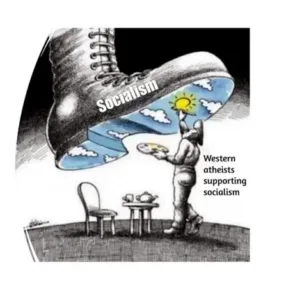
Socialist regimes tend to be both atheistic and authoritarian. Socialists see economic equality as the summum bonum of society while Christians know that “man does not live by bread alone.” They know that man has a transcendent destiny and that his life and all the goods associated with that life are given to him, not by the state, but by God and that God’s goodness merits a response of gratitude, worship and obedience. In appropriating for itself vast power and authority over the lives of its citizens, the socialist state takes on a “godlike” role. It is not surprising that atheistic socialist leaders often move from rhetorical antipathy for religion to overt violence against its practitioners. Pope John Paul II put it this way: “When people think they possess the secret of a perfect social organization which makes evil impossible, they also think that they can use any means, including violence and deceit, in order to bring that organization into being. Politics then becomes a ‘secular religion’ which operates under the illusion of creating paradise in this world.” (Centesimus Annus 25)
“Work is a good thing for man—a good thing for his humanity—because through work man not only transforms nature, adapting it to his own needs, but he also achieves fulfilment as a human being and indeed, in a sense, becomes ‘more a human being’.”
Socialism tends to denigrate the vocation of remunerative labor. Attempts to pit workers against employers breed resentment and envy which eventuate in violent rhetoric and action. By guaranteeing equal economic outcomes for all, socialist systems disincentivize initiative and hard work, and foster the vices of sloth and negligence. On the contrary, Catholics see labor as a good and necessary thing for man which enables him to use his intellect, creativity and physical strength to shape his environment and his future.
“There are many human needs which find no place on the market. It is a strict duty of justice and truth not to allow fundamental human needs to remain unsatisfied… Even prior to the logic of a fair exchange of goods… there exists something which is due to man because he is man.”
In her denunciation of socialism, the Church does not deny or downplay the very real social and economic inequalities which this flawed system purports to address. Concern about these issues is very much in keeping with the Gospel’s mandate of charity and the preferential option for the poor. Unbridled laissez-faire capitalism, in the same way as socialism, can fall into the anthropological error of reducing man to a merely economic factor of production. Many popes have issued grave warnings about the inability of market forces alone adequately to serve the common good and the dignity of each human person. She teaches that “Reasonable regulation of the marketplace and economic initiatives, in keeping with a just hierarchy of values and a view to the common good, is to be commended.” (CCC 2425)
“Such just demands and desire [for reforms to address the needs of the poor and working class] have nothing in them now which is inconsistent with Christian truth, and much less are they special to Socialism. Those who work solely toward such ends have, therefore, no reason to become socialists.”
It is undeniable that gross income disparities, failure of education, corporate greed, class envy, governmental mismanagement and corruption, automation and lack of economic opportunity have made it difficult for many families to provide adequately for themselves and to enjoy the blessings of capitalism. Many—in this country and throughout the world—are subjected to working and living conditions not in keeping with their dignity or with our responsibility to them as our brothers. Nonetheless, these evils are and should be addressed in accordance with Christian moral principles and the virtue of charity. Adoption of a socialist system with all of its attendant and inevitable evils is hardly the way to address these inequities. As Pope Pius XI said nearly a century ago, “no one can be at the same time a good Catholic and a true socialist.”
As a non-partisan organization, Catholic Citizens of Illinois does not, except in cases of the most incontrovertible moral issues, presume to recommend specific policy positions or electoral choices to our members and readers. Instead, in fidelity to Scripture, Tradition and the Magisterium of the Church, we hope to draw attention to the roots of every social issue in a Catholic understanding of the sovereignty of God and the dignity of every human person. We invite our members to look deeply and prayerfully into the moral implications of all the decisions we make as citizens of our local, state and national governments, realizing that, in the end, we are ultimately ordered to citizenship in the everlasting City of the Heavenly Jerusalem.
The foregoing is merely a brief overview of the moral, social, anthropological and historical errors of socialism. For an accessible summary of the Church’s teaching, see Can a Catholic Be a Socialist: The Answer Is No—Here’s Why by Trent Horn and Catherine R. Pakaluk. Although a discussion of the distributist alternative to both capitalism and socialism is beyond the scope of this article, this system is outlined well in The Third Way: Foundations of Distributism as contained in the writings of Pope Blessed Leo XIII and G. K. Chesterton. Read on Amazon.