 Those charged with promulgating and enforcing policy regarding immigration by foreigners into this country must prayerfully and prudently weigh and balance the following three firmly established principles of Catholic social teaching on this topic. All are ordered to the promotion of the common good, the foundation of all Catholic social thought. These principles may from time to time be in tension. In keeping with the complexity and profundity of the human person made by God the Father and redeemed by God the Son and as with so much else in Church doctrine, these principles are a matter of “both-and” – not “either-or”.
The following authorities from the three sources of Catholic teaching – Scripture, Magisterium and Sacred Tradition – will assist the Catholic citizen in the exercise of his right to vote and otherwise influence policy. You will also find comments made by recent popes which may or may not rise to the level of Magisterial teaching. Some of them you may find surprising.
 Thou shalt not molest a stranger, nor afflict him: for yourselves also were strangers in the land of Egypt. Exodus 22: 21
And do you therefore love strangers, because you also were strangers in the land of Egypt. Deut. 10:19
Keep ye my ordinances and my judgments, and do not any of these abominations: neither any of our own nation, nor any stranger that sojourneth among you. Lev. 18:26
Amen I say to you, as long as you did it to one of these my least brethren, you did it to me. Matt. 25:40
For also, when we were with you, this we declared to you: that, if any man will not work, neither let him eat. 2 Thess. 3:10
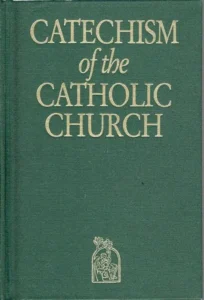 ¶ 2241 The more prosperous nations are obliged, to the extent they are able, to welcome the foreigner in search of the security and the means of livelihood which he cannot find in his country of origin. Public authorities should see to it that the natural right is respected that places a guest under the protection of those who receive him.
Political authorities, for the sake of the common good for which they are responsible, may make the exercise of the right to immigrate subject to various juridical conditions, especially with regard to the immigrants’ duties toward their country of adoption. Immigrants are obliged to respect with gratitude the material and spiritual heritage of the country that receives them, to obey its laws and to assist in carrying civic burdens.
¶ 1909 Finally, the common good requires peace, that is, the stability and security of a just order. It presupposes that authority should ensure by morally acceptable means the security of society and its members. It is the basis of the right to legitimate personal and collective defense.
Pope Leo XIV: All these immigrants continue to come. It’s a huge problem, and it’s a problem worldwide, not only in this country. There’s got to be a way both to solve the problem, but also to treat people with respect.
Pope Francis: The rightly formed conscience cannot fail to make a critical judgment and express its disagreement with any measure that tacitly or explicitly identifies the illegal status of some migrants with criminality. At the same time, one must recognize the right of a nation to defend itself and keep communities safe from those who have committed violent or serious crimes while in the country or prior to arrival. That said, the act of deporting people who in many cases have left their own land for reasons of extreme poverty, insecurity, exploitation, persecution or serious deterioration of the environment, damages the dignity of many men and women, and of entire families, and places them in a state of particular vulnerability and defenselessness. 2025 Letter of the Holy Father Francis to the Bishops of the United States of America
Pope Francis: Can borders be controlled? Yes, each country has a right to control its borders — who enters and who leaves — and countries that are in danger of terrorism or the like, have more right to control them more. January 22, 2017 Interview with Spanish newspaper El País
Pope Benedict XVI: Certainly every state has the right to regulate migration and to enact policies dictated by the general requirements of the common good, albeit always in safeguarding respect for the dignity of each human person. The right of persons to migrate …is numbered among the fundamental human rights, allowing persons to settle wherever they consider best for the realization of their abilities, aspirations and plans. In the current social and political context, however, even before the right to migrate, there is need to reaffirm the right not to emigrate, that is, to remain in one’s homeland; as Blessed John Paul II stated: “It is a basic human right to live in one’s own country. However these rights become effective only if the factors that urge people to emigrate are constantly kept under control”. Message of His Holiness Pope Benedict XVI for the World Day of Migrants and Refugees (2013)
The Church recognizes this right … to leave one’s country and the possibility to enter another country to look for better conditions of life… At the same time, States have the right to regulate migration flows and to defend their own frontiers, always guaranteeing the respect due to the dignity of each and every human person. Immigrants, moreover, have the duty to integrate into the host Country, respecting its laws and its national identity. The challenge is to combine the welcome due to every human being, especially when in need, with a reckoning of what is necessary for both the local inhabitants and the new arrivals to live a dignified and peaceful life. Message of His Holiness Benedict XVI for the World Day of Migrants and Refugees (2011)
St. Pope John Paul II: Illegal immigration should be prevented, but it is also essential to combat vigorously the criminal activities which exploit illegal immigrants. The most appropriate choice, which will yield consistent and long-lasting results is that of international co-operation which aims to foster political stability and to eliminate underdevelopment. The present economic and social imbalance, which to a large extent encourages the migratory flow, should not be seen as something inevitable, but as a challenge to the human race’s sense of responsibility. Message of Pope John Paul II for World Migration Day, 1996
Pontifical Commission on Justice and Peace: It is up to the public powers who are responsible for the common good to determine the number of refugees or immigrants which their country can accept, taking into consideration its possibilities for employment and its perspectives for development but also the urgency of the need of other people. The State must also see to it that a serious social imbalance is not created which would be accompanied by sociological phenomena of rejection such as those which can occur when an overly heavy concentration of persons from another culture is perceived as directly threatening the identity and customs of the local community that receives them. The Church and Racism: Towards a More Fraternal Society, 1988
Conclusion: As the Church teachings cited above make clear, the issue of immigration for the Catholic is a complex one that touches on the deepest questions concerning the dignity of the human person and requires a careful balancing of competing principles and interests. We at Catholic Citizens of Illinois encourage our members to consider the totality of this teaching and prayerfully to exercise the virtues of prudence and charity in coming to conclusions and casting votes related to this important issue.